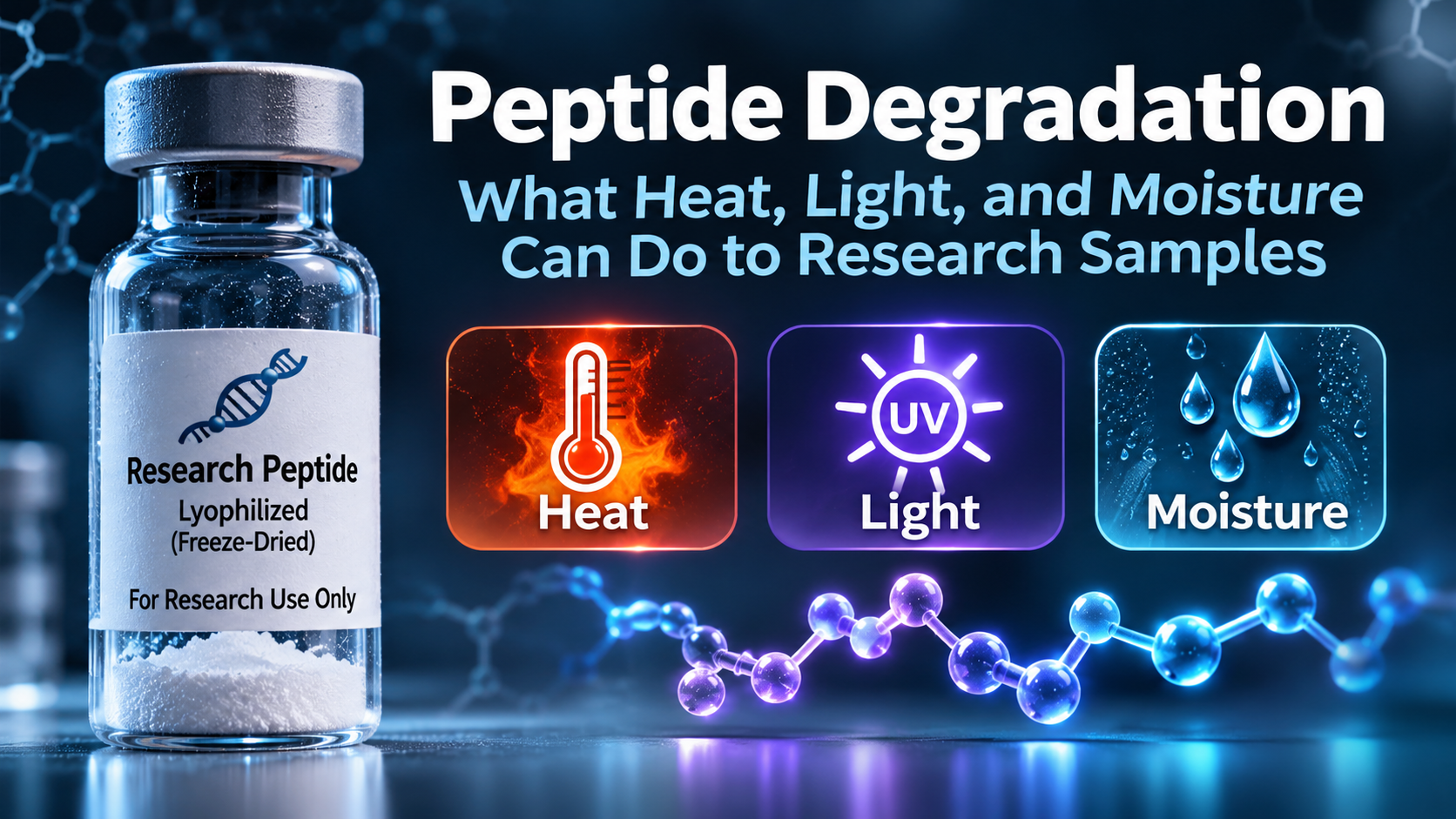
Peptides are widely used in laboratory research because of their highly specific structures and biological properties. However, those same molecular characteristics can also make peptides sensitive to environmental conditions.
Temperature, light, moisture, oxygen, and repeated handling can all potentially affect the stability of a peptide sample over time.
Understanding peptide degradation is therefore an important part of maintaining consistency and reliability in laboratory research.
What Is Peptide Degradation?
Peptide degradation refers to chemical or physical changes that alter the original structure or condition of a peptide.
Peptides are composed of chains of amino acids connected by peptide bonds. Depending on the peptide’s sequence and surrounding environment, different reactions can occur that affect its stability.
Common degradation pathways can include:
- Oxidation
- Hydrolysis
- Deamidation
- Aggregation
- Changes caused by excessive heat or light
- Moisture-related instability
Not every peptide responds to environmental conditions in exactly the same way. Stability depends heavily on the individual peptide, its formulation, and how it is stored and handled.
How Heat Can Affect Peptide Stability
Temperature is one of the most important factors influencing chemical stability.
As temperatures increase, many chemical reactions occur more rapidly. For peptide samples, prolonged exposure to excessive heat may accelerate reactions that gradually alter the molecule.
This is one reason manufacturers and laboratories establish specific storage conditions for different research materials.
However, there isn’t one universal temperature rule that applies to every peptide. The appropriate storage conditions depend on the individual compound and its formulation.
Researchers should therefore follow the storage specifications associated with the particular material they’re working with rather than assuming all peptides have identical requirements.
How Light Can Affect Research Peptides
Light exposure can also contribute to degradation in certain compounds.
High-energy light, particularly ultraviolet (UV) light, can trigger photochemical reactions in susceptible molecules. Certain amino-acid residues may be more vulnerable to these reactions than others.
This is why some laboratory materials are packaged in containers designed to reduce light exposure.
Keeping research materials away from unnecessary direct sunlight or intense light sources can help minimize an environmental variable that may otherwise affect sample stability.
Why Moisture Matters
Moisture can be particularly important when dealing with lyophilized, or freeze-dried, peptides.
Lyophilization removes water from a material to produce a dry product. One reason this technique is widely used in laboratory and pharmaceutical settings is that removing water can improve the stability of certain compounds.
If a lyophilized material is repeatedly exposed to humidity or moisture, however, some of the benefits of maintaining that dry environment may be reduced.
This is why proper container closure and storage conditions matter when working with moisture-sensitive research materials.
Oxygen and Oxidation
Oxygen is another environmental factor that can affect certain peptides.
Some amino-acid residues are particularly susceptible to oxidation, which can change the chemical structure of a peptide.
The degree to which oxidation matters depends on the peptide’s sequence, formulation, environmental exposure, and storage duration.
Oxidation is also one reason analytical testing is valuable: changes that aren’t necessarily obvious from appearance alone may sometimes be detectable using laboratory techniques.
Does a Peptide’s Appearance Tell You Whether It Has Degraded?
Not necessarily.
Visible changes can sometimes indicate that something has happened to a sample, but appearance alone cannot establish peptide identity, purity, or stability.
A peptide could potentially undergo chemical changes without producing an obvious visual difference.
Likewise, differences in the appearance of lyophilized material don’t automatically prove that degradation has occurred.
Analytical testing is required when researchers need objective information about the chemical characteristics of a sample.
Lyophilized Peptides and Stability
Many research peptides are supplied in lyophilized form.
During lyophilization, a material is frozen and water is removed under controlled conditions. The resulting dry material can offer improved stability compared with some solutions.
That doesn’t mean lyophilized peptides are indestructible.
Environmental conditions still matter, including:
Temperature: Excessive heat may accelerate degradation reactions.
Moisture: Humidity can affect materials intended to remain dry.
Light: Certain molecules may be susceptible to photochemical degradation.
Oxygen: Susceptible amino-acid residues may undergo oxidation.
The specific stability profile still depends on the individual peptide.
Why Peptide Stability Matters in Research
Sample integrity matters because researchers need confidence that the material being studied remains reasonably consistent throughout an experiment.
If a research compound changes significantly because of inappropriate storage or environmental exposure, it can introduce another variable into the research.
That can make results more difficult to interpret or reproduce.
Proper storage isn’t simply about preserving a product—it’s part of maintaining experimental consistency.
Storage Instructions Should Be Compound-Specific
One of the biggest mistakes when discussing peptide storage online is treating every peptide as though it behaves identically.
They don’t.
Different amino-acid sequences can have different chemical properties and vulnerabilities. Formulation, packaging, physical state, and intended storage period can also influence appropriate conditions.
Researchers should rely on compound-specific documentation and validated storage information whenever available.
The Bottom Line
Peptides are complex molecules, and their stability can be influenced by their surrounding environment.
Heat, light, moisture, and oxygen may contribute to degradation under certain conditions, although the extent and mechanism depend on the individual peptide and its formulation.
Understanding these factors helps researchers minimize unnecessary environmental exposure and maintain more consistent research samples.
At Pure Peptides, our products are supplied strictly for research purposes. Information provided here is educational and is not intended as medical advice or instructions for human use.