
Peptides are short chains of amino acids that serve as essential tools in biochemical research. Whether you are studying receptor binding, enzyme inhibition, or signaling pathways, a solid grasp of peptide sequences can dramatically improve the quality of your experiments.
What Makes a Peptide Sequence Unique?
A peptide sequence is defined by the order of its constituent amino acids. This order determines the molecule’s three‑dimensional shape, its charge distribution, and ultimately its biological activity. When you order a peptide from Pure Peptides, the sequence you provide is translated into a custom‑synthesized product that mirrors your design with high fidelity.
Reading and Interpreting the One‑Letter Code
Most peptide specifications use the standard one‑letter amino acid code (e.g., A for Alanine, R for Arginine). Below is a quick reference table:
- A – Alanine
- R – Arginine
- N – Asparagine
- D – Aspartic Acid
- C – Cysteine
- E – Glutamic Acid
- Q – Glutamine
- G – Glycine
- H – Histidine
- I – Isoleucine
- L – Leucine
- K – Lysine
- M – Methionine
- F – Phenylalanine
- P – Proline
- S – Serine
- T – Threonine
- W – Tryptophan
- Y – Tyrosine
- V – Valine
Design Tips for Reliable Peptide Synthesis
When planning a peptide, keep these guidelines in mind:
- Length matters: Short peptides (5‑12 residues) synthesize more efficiently and are cheaper. Longer sequences may require special coupling strategies.
- Consider solubility: Add charged residues (e.g., Lysine, Arginine) to improve aqueous solubility.
- Protect reactive side chains: Use protecting groups (e.g., t‑Bu for Serine) if you need to avoid side‑chain reactions during synthesis.
- Check for repeats: Repeated motifs can lead to mis‑incorporation; redesign if possible.
Quality Assurance at Pure Peptides
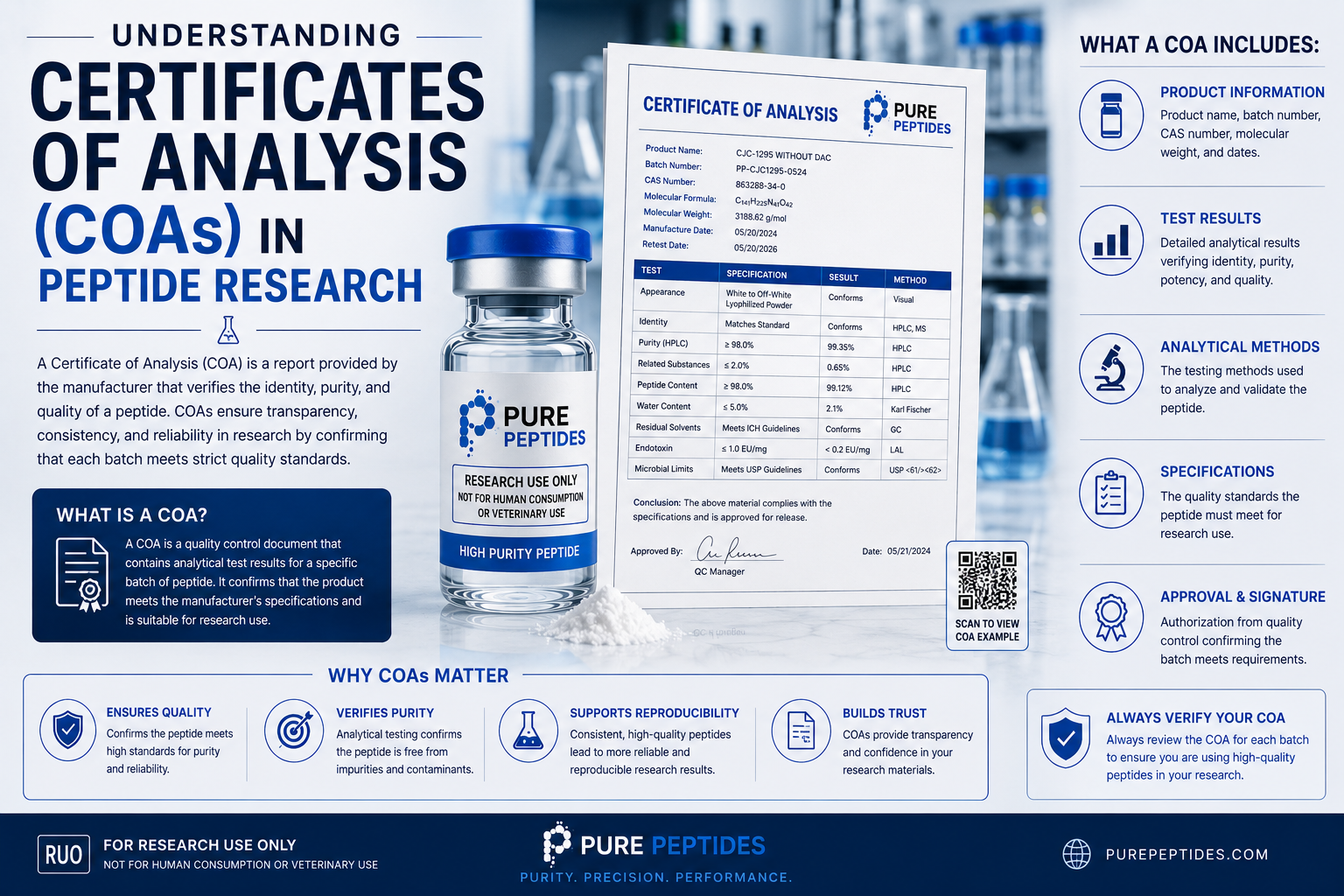
All peptides are provided with a certificate of analysis (COA) that includes:
- Purity level (≥95% for research grade)
- Mass spectrometry confirmation
- HPLC chromatogram
These data give you confidence that the product matches the sequence you submitted.
Practical Applications
Accurate sequences enable a range of experiments, such as:
- Binding assays for receptor‑ligand studies
- In‑vitro enzymatic inhibition
- Peptide‑based vaccine design
- Structural analysis using NMR or X‑ray crystallography
Final Thoughts
Invest time in designing clean, well‑documented peptide sequences. Doing so reduces synthesis errors, improves reproducibility, and ultimately speeds up your research timeline. Pure Peptides is ready to turn your design into a high‑quality research reagent—just be sure to follow the handling guidelines in our next post.